Coffee isn’t just a drink — it’s an experience shared by millions of people around the world. It’s the ritual that starts our mornings, the warm cup at a café with friends, and the product of countless hands working from farm to cup. And for the people who serve that cup for a living, coffee is also a business — one that depends on more than a great roast. It depends on whether the customer down the street can actually find your café on Google before they walk into your competitor’s instead.
In this journey, we’ll explore coffee’s story, its path across continents, and the ways it shapes daily life — and along the way, we’ll look at what all of this history and culture actually means for the independent cafés serving it today.
What is Coffee? The Fundamental Brew
Essentially, coffee is a liquid drink made from the roasted seeds — or, more loosely, beans — of the coffee plant. These beans are found within red or purple fruits commonly known as coffee cherries.
Picked, processed, roasted, and ground, these beans release an aromatic, frequently energizing drink. The primary psychoactive ingredient in coffee is caffeine, a natural stimulant many people rely on to start their day or push through an afternoon slump.
The coffee genus contains many species, but only a few are grown for commercial purposes. Coffee farming thrives in the “Bean Belt,” a zone surrounding the equator where steady temperatures and rainfall create ideal growing conditions.
The trip from a healthy green cherry on a bush to the dark, fragrant grounds in your cup is long and complex, requiring skilled human labor at every stage and very specific environmental conditions. It’s a story worth telling — and one that gives independent cafés something the big chains can’t easily copy: an authentic origin story customers actually want to hear. Cafés that turn this kind of storytelling into consistent content strategy tend to build a stronger connection with local customers than cafés that treat their menu as an afterthought online.
Two Core Types of Coffee (Beverage Preparations)
When people talk about “types of coffee” in the finished-drink sense, they’re usually talking about two things: the plant species behind the bean, and the brewing method used to prepare it.
Let’s look at the two most fundamental brewing styles, which highlight just how versatile coffee can be:
Black Coffee — The purest form of coffee: plain brewed coffee and hot water. It lays bare the intrinsic flavor, acidity, and body of the bean without additions. Many drinkers prefer it black specifically to taste the subtleties added by origin, roast, and brewing method.
Espresso — A concentrated coffee shot produced by forcing pressurized hot water through finely ground beans. The technique pulls a thick, syrupy liquid capped with a reddish-brown foam known as crema. Espresso is the base for a wide range of mainstream drinks — lattes, cappuccinos, macchiatos, and Americanos — where it’s combined with steamed milk, foam, or water.
Beyond these two, there’s an entire world of coffee preparations: pour-overs, French press, cold brew, Turkish coffee, and countless regional variations, each offering a distinct sensory experience. A menu that explains these differences well doesn’t just help walk-in customers order with confidence — it also gives a café real, useful content to publish online, the kind that search engines reward far more than a generic “Welcome to our coffee shop” homepage.
Etymology: Following “Coffee” Back to Its Roots
The word “coffee” has a genuinely compelling etymology, tracing its spread across cultures and centuries:
Arabic Origins — The term is commonly traced to the Arabic word “qahwah” (قهوة), which initially referred to a type of wine or intoxicating beverage. As coffee’s stimulating effects became known, the word was applied to this new drink, which offered its own kind of “exhilaration.”
Turkish Adaptation — From the Arab world, coffee spread into the Ottoman Empire, where the name shifted to “kahve.” The Turks helped popularize coffee houses, which became important centers of intellectual and social life — arguably the first real “third places” between home and work.
Dutch Influence — European trade introduced coffee to the Netherlands, and the Dutch adapted “kahve” into “koffie.” The Dutch East India Company played a major role in spreading coffee across Europe and into their colonies.
English Adoption — Early in the 17th century, the English adopted the borrowed Dutch word, and “coffee” entered the dictionary, where it has remained ever since.
This linguistic journey mirrors coffee’s historical path — from East African origins, through the Middle East, into Europe, and eventually the world. It’s also a reminder that the coffee house, as a social institution, has always been a local gathering place first. That’s exactly the role today’s independent cafés still play — which is precisely why showing up correctly in local, map-based search results matters so much for them.
Rich History of Coffee: From Goats to Global Staple
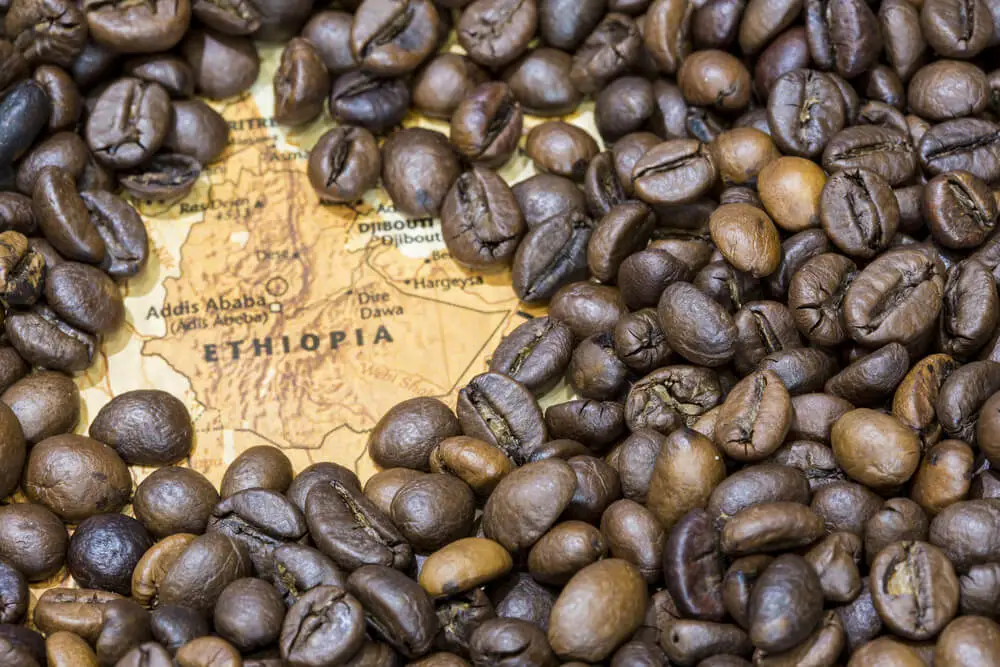
The history of coffee is full of colorful, well-documented moments, beginning in ancient Ethiopia.
The Kaldi Legend (c. 9th Century AD):
The most popular origin story involves Kaldi, an Ethiopian goat herder who noticed his goats became unusually energetic — almost “dancing” — after eating red berries from a particular tree. Kaldi tried the berries himself and felt the same energizing effect.
He shared his discovery with a local monastery, where the monks initially disapproved and threw the berries into a fire. But the sweet smell of the roasting beans convinced them to rescue the cinders, grind the beans, and dissolve them in boiling water — producing what’s often called the world’s first cup of coffee. They found it helped them stay awake through long hours of prayer.
Spread to Yemen (c. 15th Century):
Coffee beans traveled from Ethiopia across the Red Sea to Yemen, where Sufi mystics cultivated the plant for its energizing effects and used it to stay awake during religious rituals and meditation. The port city of Mocha became a major coffee export hub.
The Islamic World (15th-16th Centuries):
Coffee houses, known as kaveh kanes, appeared in cities like Mecca, Cairo, and Istanbul. These were lively centers for discussion, music, chess, and information — occasionally drawing suspicion from authorities who worried they were also hubs for political debate.
Arrival in Europe (17th Century):
Venetian traders introduced coffee to Europe in the early 1600s. It was initially met with suspicion, with some clergy reportedly calling it “the bitter invention of Satan.”

According to legend, Pope Clement VIII tasted it, found it delicious, and gave it his blessing. Coffee houses soon opened across European capitals like London, Paris, and Vienna, becoming centers of social life, trade, and intellectual exchange during the Enlightenment.
Global Expansion (17th-18th Centuries):
European colonial powers, especially the French and the Dutch, began growing coffee in colonies across Asia, the Caribbean, and South America, launching coffee’s rise as a true international commodity.
It’s a story that traces coffee’s evolution from a local novelty into a global favorite — and a reminder that every great café today is, in its own small way, continuing a tradition of local gathering places that stretches back over a thousand years.
“Coffee” in Other Languages: A Tribute to Global Popularity
Coffee’s global popularity shows up clearly in how many languages have adapted a version of the word — most tracing back to its Turkish and Arabic roots:
| Language | Word |
|---|---|
| French | café |
| German | Kaffee |
| Spanish | café |
| Italian | caffè |
| Portuguese | café |
| Dutch | koffie (the origin of the English name) |
| Russian | kofe (кофе) |
| Japanese | kōhī (コーヒー) |
| Chinese (Mandarin) | kāfēi (咖啡) |
| Turkish | kahve |
| Arabic | qahwah (قهوة) |
| Greek | kafés (καφές) |
| Swedish | kaffe |
This linguistic diversity underscores coffee’s international status — a product that crosses cultural and geographical lines effortlessly. It’s also a small but useful reminder for café owners in diverse U.S. cities: local customers searching for a coffee shop online don’t all phrase things the same way, which is one of the many small details that a properly built Google Business Profile is designed to capture.
Coffee: Essential Facts and Figures
Behind the everyday cup is a picture of genuinely massive social and economic influence:
Second Most Traded Commodity:
Coffee is often cited as the second most valuable legally traded commodity in the world, after crude oil, reflecting its enormous footprint in global commerce, according to data compiled by the International Coffee Organization.
Global Value of Industry:
The worldwide coffee industry is valued at well over $100 billion a year, spanning cultivation, processing, trade, roasting, retail, and related services, per figures tracked by Statista’s coffee industry research.
Daily Consumption
Roughly 2.25 billion cups of coffee are consumed worldwide every single day, making it one of the most-consumed beverages on the planet.
Economic Impacts on Exporting Countries:
Exports of coffee for most developing countries are a major source of earnings from abroad and jobs. Coffee is a source of living for millions of farmers and their families.
For example, coffee in Ethiopia is a source of export earnings and provides employment for millions.
Largest Consumers:
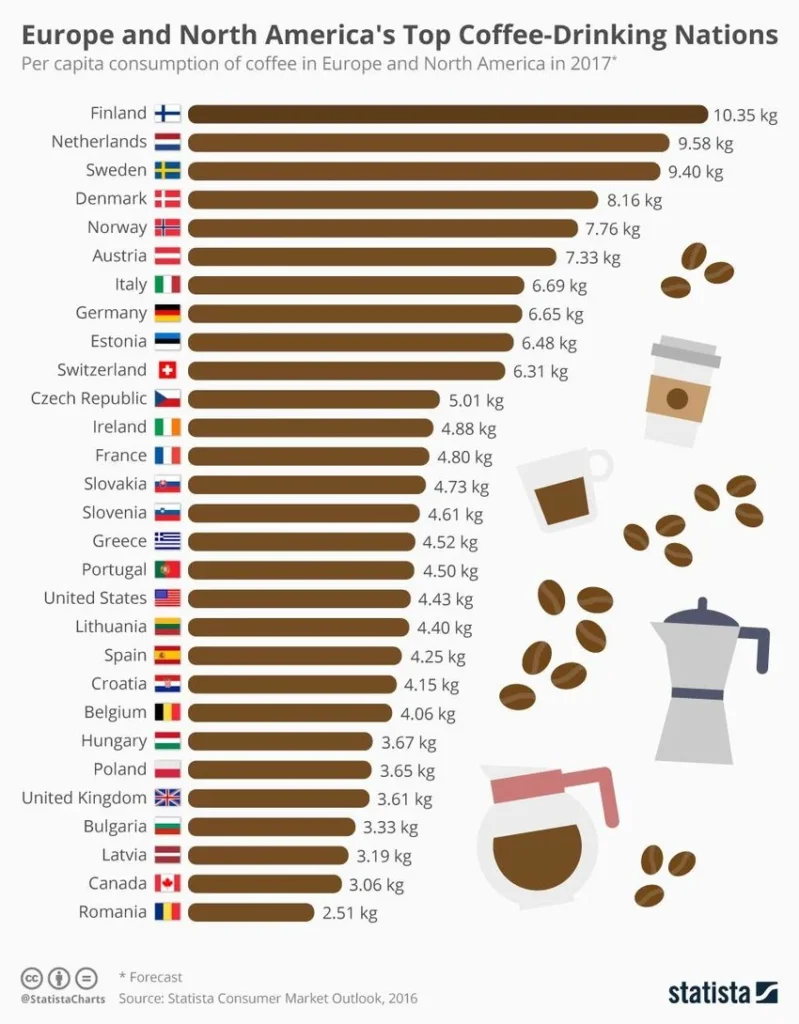
While most production happens in the Global South, the highest per-capita consumption is typically found in Scandinavian countries (Denmark, Finland, Norway, Iceland, Sweden) and elsewhere in Europe. The United States remains the single largest market by total volume.
Employment:
The coffee industry employs an estimated 25 million people worldwide, spanning production, distribution, and retail.
These numbers highlight coffee’s role not just as a beverage, but as a genuine pillar of the global economy — and a reminder of just how crowded and competitive the local coffee shop market has become in nearly every U.S. city.
Great Coffee Isn’t Enough Anymore — Why Cafés Need to Be Found Online
Here’s the part most coffee content skips over: none of this history, culture, or craft matters to a customer who never finds your café in the first place.
Someone within walking distance of your shop searches “best coffee near me” right now — and lands on a competitor. Not because their coffee is better. Because Google showed that competitor first. This is the single biggest, and most fixable, problem independent cafés face today.
A few realities worth knowing:
- The vast majority of local customers never scroll past the top three results in Google’s map pack. If your café isn’t there, you’re likely losing dozens of potential walk-ins every week, based on patterns documented in BrightLocal’s local consumer search research.
- An incomplete Google Business Profile signals to both Google and customers that a business isn’t actively maintained — which directly hurts how often it gets shown and how many calls it receives.
- A beautiful café website means very little if it loads slowly and has no local keywords for Google to read. It becomes a digital brochure that never actually brings anyone through the door.
This is where a shop’s understanding of its own coffee — its origin, its brewing methods, its story — actually becomes a competitive advantage, but only if it’s paired with the technical and local visibility work that gets that story in front of nearby customers. That combination is exactly what local SEO for coffee cafés is built to solve: optimizing your Google Business Profile, fixing the technical issues slowing your site down, and building the kind of location-specific content that ranks for real searches happening in your neighborhood.
Google itself outlines the fundamentals of how local and organic search ranking works in its own Search Central documentation — worth a read for any café owner who wants to understand the mechanics, even before working with an agency.
For café owners who want a clear, jargon-free look at where they currently stand, a free revenue audit is usually the fastest way to see exactly what’s costing walk-ins — incomplete listings, slow load times, thin review counts, or missing content — and what a realistic 90-day plan to fix it looks like. You can see the full process laid out step by step on the how it works page.
This isn’t a one-city problem, either. Independent cafés in competitive markets like Austin, Denver, Nashville, and Portland are all fighting the same visibility battle against chains with far bigger marketing budgets — and consistently, the cafés that invest in local search are the ones filling tables while their neighbors wonder where the foot traffic went.
Turning Coffee Knowledge Into Marketing That Fills Tables
Everything covered above — the history, the etymology, the brewing methods, the global stats — isn’t just trivia. For a café, it’s raw material. Customers respond to businesses that clearly know and love what they sell, and search engines respond to websites that publish genuinely useful, specific content instead of generic filler.
A few practical ways independent cafés put this into action:
- Menu descriptions that teach, not just list. Explaining what makes a pour-over different from an espresso, or where a single-origin bean comes from, turns a menu into content customers screenshot and share.
- Blog content tied to real search intent. Posts answering specific questions — what a drink is, how to make something at home, what a term means — consistently earn organic traffic long after they’re published. You can see this approach in practice across the wider IboBeans blog, including deep dives like what white coffee actually is and even lifestyle angles like coffee’s benefits for skin.
- Local storytelling. Tying a café’s history, sourcing, or roasting process to its specific neighborhood gives Google — and customers — a reason to see the business as a genuine local fixture, not just another listing.
- Technical health. None of the above matters if the site itself is slow, unindexed, or missing basic local signals. This is the unglamorous but essential foundation covered under technical SEO.
The cafés winning right now aren’t necessarily the ones with the best-kept secret recipe. They’re the ones combining real craft with the visibility work that gets that craft in front of the people already searching for it.
The Bottom Line
Coffee’s story — from Kaldi’s dancing goats to a $100+ billion global industry — is genuinely one of the great human stories of trade, culture, and daily ritual. But for the people running a café today, that story only pays the bills if customers can actually find the door.
Great coffee gets people to come back. Being visible on Google is what gets them to walk in the first place. If you’re not sure where your café currently stands, see the full IboBeans service breakdown or get a free revenue audit to see exactly where you’re losing customers — and what it would take to fix it.
5 thoughts on “Coffee: The World in a Cup (And Why Your Cafe Still Needs to Be Found in It)”
Comments are closed.
Haha, caught me in the loop! Thanks for the 10/10 — I’ll take the recursion as a win. Let me know if you want the next level comment… or should we break free?
Thanks for the iced coffee love! ☕❄️ You’re so right—quick, customizable, and way cheaper than the café line. But wait till you try using that leftover iced coffee in a DIY face scrub—exfoliates like a dream and gives that natural glow! (Full recipe in the post ) What’s your go-to iced coffee twist?