Article Summary
Most cafe owners already know great coffee isn’t enough anymore — customers decide where to go before they ever walk through the door, and that decision usually starts with a Google search. This guide breaks down exactly how local SEO services for cafes work, what a real strategy includes (Google Business Profile optimization, citations, schema, reviews, content, technical SEO), what it costs, how long it takes, and the mistakes that quietly cost cafes their local rankings. It’s written for cafe owners, coffee shop chains, and marketing managers who want a plan, not just theory.
Introduction
Picture your last few customers before they ever ordered a drink. Chances are, most of them typed something like “coffee shop near me” or “best latte in [their neighborhood]” into their phone while standing a few blocks away, deciding where to walk. That single search, and what Google shows them in the next three seconds, often decides whether they come to you or your competitor down the street.
That’s the entire game behind local SEO services for cafes. It isn’t about outranking Starbucks nationally. It’s about making sure that when someone nearby is thirsty, hungry, or looking for a place to sit with their laptop, your cafe is the one Google puts in front of them — in the Map Pack, in the local search results, and on Google Maps itself.
We’ve worked with independent coffee shops, multi-location cafe chains, and franchise owners across the country, and the pattern is always the same: cafes with strong local SEO get a steady stream of walk-ins without paying for every single customer through ads. Cafes without it are invisible to the exact people searching for them right now. This guide walks through everything that separates the two.
1. What Local SEO Actually Means for a Cafe
Local SEO is the process of optimizing your cafe’s online presence so it shows up when nearby customers search for coffee, breakfast, brunch, or a place to work. It’s different from general SEO because it’s tied to geography — your neighborhood, your city, and the radius customers are actually willing to travel.
For a cafe, local SEO covers:
- Your Google Business Profile (formerly Google My Business)
- Your website’s structure, speed, and content
- Citations across directories like Yelp, TripAdvisor, and Apple Maps
- Reviews and how you manage them
- Schema markup that tells Google exactly what kind of business you are
- Local content built around your neighborhood, menu, and community
2. Why Local SEO Matters More for Cafes Than Almost Any Other Business
Coffee is an impulse and convenience purchase. Nobody drives across town for a flat white when there are three cafes closer. That makes proximity and visibility the two biggest factors in whether someone chooses you.
Did You Know? The majority of people researching a nearby coffee shop or restaurant do it on their phone, often within minutes of deciding they want coffee — meaning your cafe has a very short window to be found before they pick somewhere else.
This is why ranking in the Local 3-Pack (the three map-pinned results Google shows above the organic listings) matters so much for cafes specifically. If you’re not in it, you’re competing for scraps further down the page, where most people never scroll.
Quick Win: If you do nothing else this month, claim and fully complete your Google Business Profile. It’s free, and it’s the single highest-leverage local SEO move available to any cafe.
3. How Google Decides Which Cafes Rank in the Map Pack
Google’s local ranking algorithm weighs three main factors:
| Ranking Factor | What It Means for a Cafe |
|---|---|
| Relevance | Does your listing and website clearly match the search — “coffee shop,” “brunch spot,” “cafe with WiFi”? |
| Distance | How close is your cafe to the person searching or the location they typed? |
| Prominence | How well-known and well-reviewed is your cafe, both online and through backlinks/citations? |
You can’t control distance. But relevance and prominence are almost entirely within your control — and that’s where local SEO services for cafes focus most of their effort.
4. The Core Components of Local SEO Services for Cafes
A real cafe SEO strategy isn’t one tactic — it’s several working together. Here’s the full stack:
- Google Business Profile optimization
- NAP consistency and citation building
- Review generation and review management
- On-page and technical SEO (speed, mobile, schema)
- Local content and city/neighborhood pages
- Local link building
- Ongoing tracking through Google Search Console and Google Analytics
Skipping any one of these leaves gaps competitors can exploit. A cafe with a perfect Google Business Profile but a slow, unoptimized website will still lose customers who click through and bounce.
5. Google Business Profile Optimization for Coffee Shops
Your Google Business Profile (GBP) is the closest thing to a digital storefront window. Here’s what actually moves the needle:
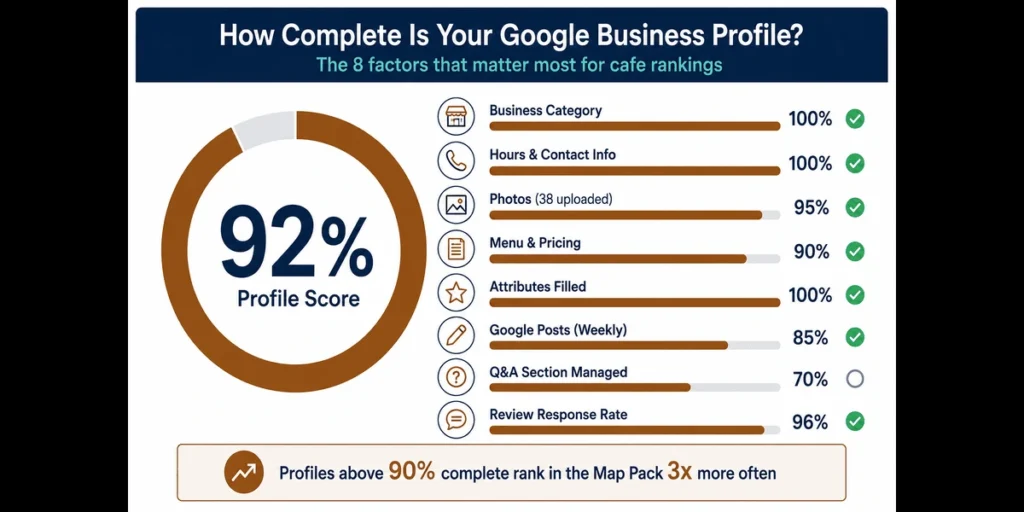
Complete every field. Category, hours, phone number, website, menu link, service options (dine-in, takeout, outdoor seating, WiFi, pet-friendly). Incomplete profiles rank worse and convert worse.
Choose the right primary category. “Coffee Shop” is usually correct for most cafes, but chains that also serve full breakfast or lunch may benefit from a secondary category like “Cafe” or “Breakfast Restaurant.”
Add fresh photos regularly, including geo-tagged images of your storefront, interior, and drinks — this signals activity and helps with Google Maps visibility.
Use Google Posts to share seasonal drinks, new menu items, and local events. Cafes that post monthly tend to see more engagement on their profile than those that never update it.
Expert Tip: Add your most popular menu items directly into your GBP description and Products section. Cafes ranking for “best cold brew near me” almost always have “cold brew” explicitly mentioned somewhere on their profile.
6. NAP Consistency and Local Citations
NAP stands for Name, Address, Phone number. Google cross-references this information across the web to verify your cafe is legitimate and located where you say it is.
Common Mistake: A cafe lists “123 Main St, Suite B” on its website but just “123 Main St” on Yelp, and an old phone number is still live on Apple Maps. These small inconsistencies quietly weaken rankings and confuse customers trying to call or find you.
Build citations on:
- Yelp
- TripAdvisor
- Apple Maps
- Bing Places
- Local chamber of commerce directories
- Local food blogs and “best of” roundups
For multi-location cafes, a quarterly NAP audit across every listing is worth the time — discrepancies pile up fast when hours change seasonally or a location moves.
7. Reviews: The Ranking Factor Cafes Underestimate
Reviews aren’t just social proof for customers — they’re a direct local ranking signal for Google. Cafes with more recent, genuine, positive reviews consistently outrank cafes with fewer or older reviews, all else being equal.
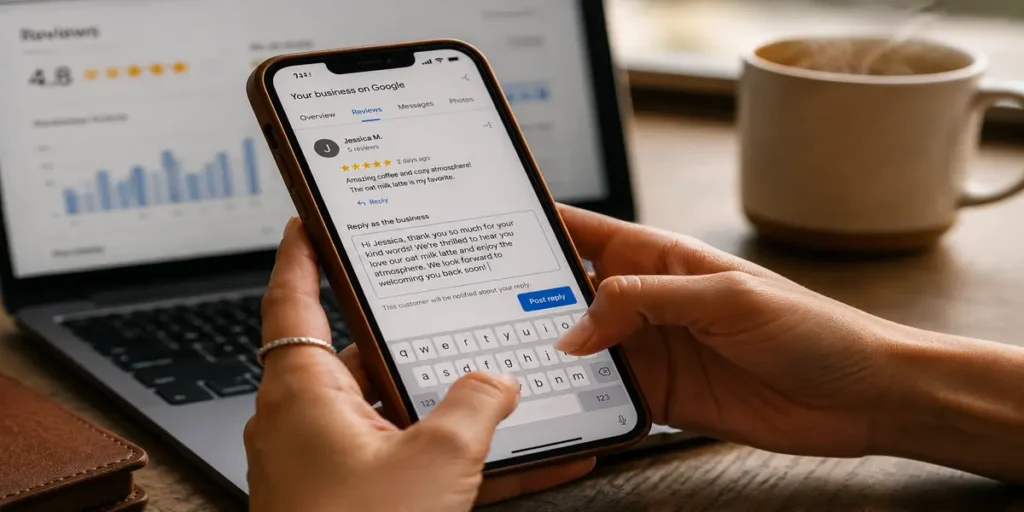
Action Steps:
- Ask happy customers in person or via a simple QR code on receipts and table tents.
- Respond to every review — good and bad — within a few days.
- Never argue with a negative review publicly. Acknowledge it, apologize if warranted, and offer to make it right offline.
- Watch for keyword-rich reviews (“best oat milk latte in downtown Austin”) — they reinforce relevance signals naturally.
Pro Tip: A thoughtful, professional response to a negative review often builds more trust with future customers than another five-star review would.
8. On-Site and Technical SEO for Cafe Websites
Your Google Business Profile gets people interested. Your website closes the deal — or loses them.
Mobile SEO: Most local searches happen on phones. If your menu is a giant PDF that takes 10 seconds to load, you’re losing customers before they see what you offer.
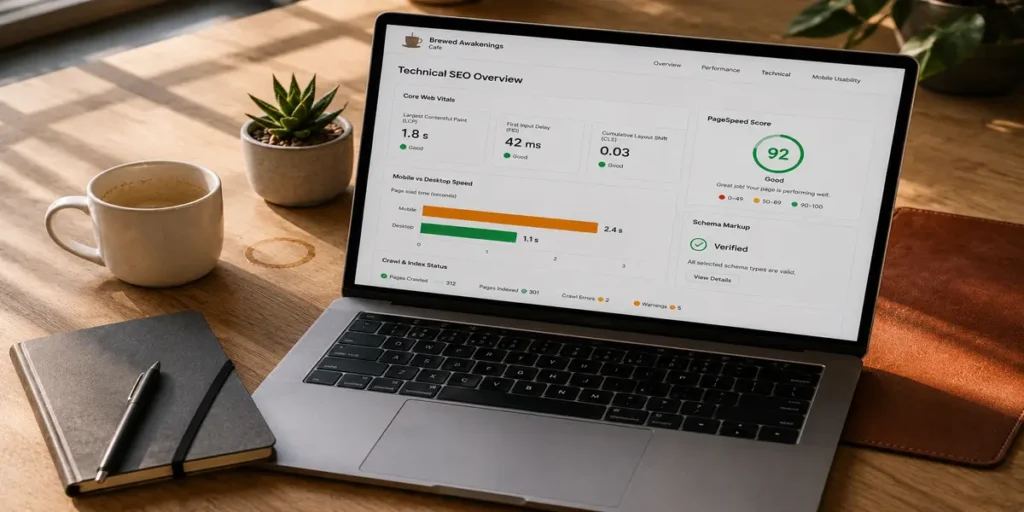
Core Web Vitals: Google measures loading speed, visual stability, and interactivity. Compress images (especially menu and food photography), avoid heavy unoptimized plugins, and test your site through Google PageSpeed Insights.
Schema markup: Implement LocalBusiness and Cafe/Restaurant schema (via Schema.org) so Google can display your hours, price range, and star rating directly in search results.
Image SEO: Name image files descriptively (“iced-oat-milk-latte-denver-cafe.jpg” instead of “IMG4821.jpg”) and use geo-tagged photos where possible, with proper alt text.
Crawlability: Submit an updated XML sitemap through Google Search Console, keep your site’s internal linking clean, and make sure important pages (menu, location, hours) aren’t buried three clicks deep.
9. Content Strategy That Builds Cafe Authority
Most cafe websites stop at a homepage and a menu page. That’s a missed opportunity. Content that supports local SEO for a cafe includes:
- Neighborhood and city pages for multi-location cafes (“Our Denver Location,” “Our Austin Location”)
- Seasonal content around new drinks, holiday menus, or local events
- “Best of” style posts like “Best Study Spots for Students in [City]” that capture long-tail, occasion-based searches
- Behind-the-scenes content about your beans, roasting process, or baristas — this builds topical authority and trust (EEAT)
Did You Know? Content built around specific occasions and neighborhoods — not just generic “coffee shop” keywords — tends to capture searchers who are further along and more ready to visit, since they’ve already added local, specific detail to their search.
10. Local Link Building for Cafes
Links from other local, relevant websites tell Google your cafe is a trusted part of the community. For cafes, the best link opportunities are usually hyperlocal:
- Local news sites covering food and drink
- Neighborhood association or chamber of commerce websites
- Local bloggers and food influencers
- Sponsorships of community events, farmers markets, or local sports teams
- Partnerships with nearby businesses (a bakery, a bookstore, a coworking space) that link to each other
Expert Tip: A single link from a well-known local food blog often carries more local ranking weight than ten generic, low-quality directory links.
11. Multi-Location and Franchise Cafe SEO
Cafe chains and franchise owners face a different challenge: every location needs its own visibility without competing against sister locations for the same searches.
- Create a dedicated page per location, each with unique content, hours, and local keywords — never a copy-pasted template.
- Set up and manage a separate Google Business Profile per location.
- Use geo-targeted keyword research so each page targets its specific neighborhood, not just the brand name.
- Maintain NAP consistency location-by-location, since each address, phone number, and hours block is different.
- Track performance per location using Google Search Console and location-level reporting.
Common Mistake: Franchise cafes often reuse identical page content across every location, swapping only the city name. Google recognizes this as thin, duplicate content, and it can suppress rankings across all locations, not just one.
12. What Local SEO Services for Cafes Cost
Pricing varies by cafe size, competition, and how many locations you’re optimizing, but here’s a general range to set expectations:
| Service Level | Typical Monthly Range | Best For |
|---|---|---|
| Basic GBP + citation management | $300–$700/month | Single-location, low-competition cafes |
| Full local SEO package (GBP, content, citations, reviews, technical) | $700–$2,000/month | Single or two-location cafes in competitive areas |
| Multi-location/franchise SEO | $2,000–$6,000+/month | Cafe chains with 3+ locations |
| One-time local SEO audit | $300–$1,000 (one-time) | Cafes wanting a starting benchmark before committing |
Most cafes start seeing measurable ranking improvements within 3 to 6 months, with continued gains as reviews, content, and citations build up over time
13. Common Local SEO Mistakes Cafe Owners Make
- Leaving Google Business Profile fields blank (“we’ll get to it later”)
- Ignoring negative reviews instead of responding professionally
- Using generic stock photos instead of real photos of the cafe and drinks
- Inconsistent NAP across directories after a move or phone number change
- A slow, non-mobile-friendly website that loses customers who already found the listing
- Duplicate content across multi-location pages
- No local content strategy — just a homepage and a menu, nothing built around neighborhood or occasion searches
Any one of these can quietly cap how high a cafe ranks, even with great coffee and loyal customers.
14. Real-World Example: A Two-Location Coffee Shop Case Study
A two-location coffee shop chain came to us ranking on page two for “coffee shop near me” in both of its neighborhoods, with an incomplete Google Business Profile and only a handful of reviews per location.
Over four months, the strategy included:
- Fully optimizing both Google Business Profiles with unique descriptions, categories, and weekly photo updates
- Fixing NAP inconsistencies across six directories
- Launching a review generation system using table tent QR codes
- Building two unique, locally written landing pages instead of one templated page
- Publishing two neighborhood-focused blog posts per month
By month four, both locations had moved into the Local 3-Pack for their primary “coffee shop near me” and “cafe in [neighborhood]” searches, and combined Google Business Profile calls and direction requests had roughly doubled compared to the baseline.
Results like this vary by market and competition level, but the pattern — complete profile, consistent NAP, active reviews, and real local content — holds across almost every cafe we’ve worked with.
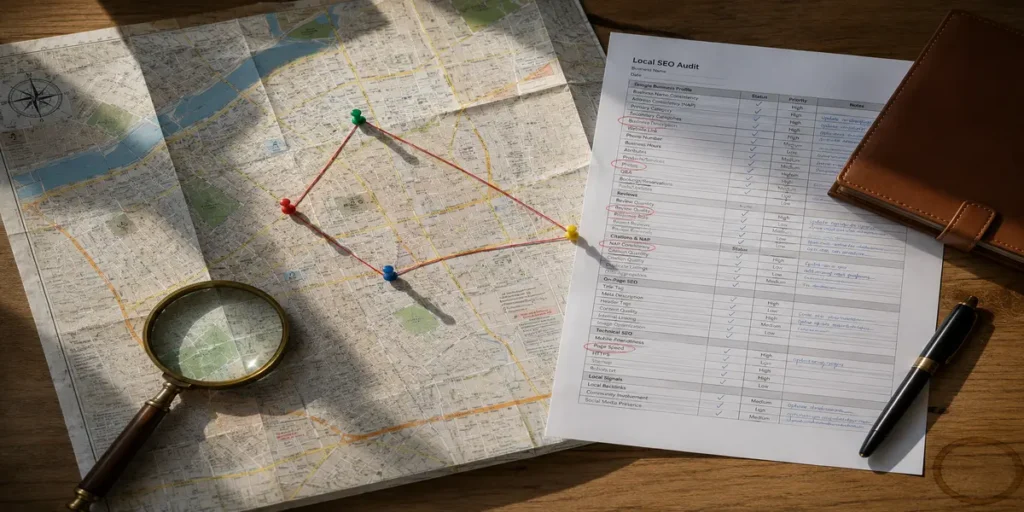
15. Local SEO Checklist for Cafe Owners
Use this as a starting audit for your own cafe:
- Google Business Profile fully completed and verified
- Correct primary (and secondary, if applicable) GBP category selected
- Fresh photos uploaded at least monthly
- NAP consistent across website, GBP, Yelp, TripAdvisor, Apple Maps
- Active review request system in place
- All reviews responded to within a few days
- Website loads quickly on mobile
- LocalBusiness/Cafe schema markup implemented
- XML sitemap submitted through Google Search Console
- Unique location page for every cafe (if multi-location)
- At least one piece of local, neighborhood-specific content published
- Local backlinks from community sites or local press
16. FAQ
1. What is local SEO for cafes? Local SEO for cafes is the process of optimizing your Google Business Profile, website, citations, and reviews so your coffee shop appears in local search results and the Google Map Pack when nearby customers search for coffee or cafes.
2. How long does local SEO take to work for a coffee shop? Most cafes see initial ranking movement within 6 to 12 weeks and stronger, more stable results by month 3 to 6, depending on competition in the area.
3. Do I need a website if I already have a strong Google Business Profile? Yes. A GBP alone can’t rank as well or convert visitors the way a fast, well-structured website can, especially for menu browsing and online ordering links.
4. How much do local SEO services for cafes cost? Costs typically range from $300 to $2,000 per month for a single location, and $2,000 or more per month for multi-location cafe chains, depending on scope.
5. What’s the single most important local SEO factor for a cafe? A fully completed, actively managed Google Business Profile combined with a steady stream of genuine reviews tends to move the needle fastest.
6. Can I do cafe SEO myself instead of hiring an agency? Yes, especially the basics — claiming your GBP, posting photos, and requesting reviews. Technical SEO, schema markup, and content strategy usually benefit from professional help as competition increases.
7. Do multiple cafe locations compete against each other in search results? They can, if each location doesn’t have its own unique, well-optimized page and Google Business Profile. Proper location-specific SEO prevents this.
8. How many reviews does a cafe need to rank well? There’s no fixed number, but consistency matters more than volume — a steady stream of recent, genuine reviews outperforms a large batch collected once and never updated.
9. Does responding to negative reviews really affect rankings? It affects trust and conversion more directly than rankings, but engagement signals overall do factor into how Google and customers perceive your cafe’s credibility.
10. What is NAP consistency, and why does it matter for a cafe? NAP stands for Name, Address, Phone number. Keeping this identical across your website and every directory helps Google confirm your cafe’s legitimacy and location accuracy.
11. Should cafes target “near me” keywords directly in their content? Not artificially. Google already understands “near me” intent based on location; cafes should instead focus content on neighborhood names, occasions, and menu items, which naturally supports those searches.
12. Is local SEO worth it for a small, independent cafe with a limited budget? Yes — local SEO is one of the most cost-effective marketing channels available, since it targets people already searching for exactly what an independent cafe offers, without ongoing ad spend.
17. Final Thoughts and Next Steps
Great coffee gets people to come back. Local SEO gets them to find you in the first place. The cafes winning their neighborhoods right now aren’t necessarily the ones with the best espresso machine — they’re the ones showing up first when someone nearby searches for a place to get one.
If you’ve read through this guide and recognized a few gaps in your own cafe’s Google Business Profile, reviews, or website, that’s a normal starting point. Most cafes we work with start exactly there.
Ready to see where your cafe stands? Get a free local SEO audit and we’ll show you exactly what’s holding your coffee shop back from ranking higher — and what it would take to fix it.